When your heating system quits at 2 AM and you're reaching for space heaters, you're making decisions that most HVAC contractors see go wrong about 40% of the time. Yes, space heaters work as emergency heating—but here's what we've learned from responding to hundreds of St. Cloud service calls: the biggest dangers aren't the ones homeowners prepare for.
During our coldest months (January through early February, when St. Cloud temperatures occasionally drop to the mid-30s), we respond to emergency calls where families have been running space heaters for days. The patterns are consistent. Homes built before 1990—common throughout St. Cloud's established neighborhoods—typically have 15-amp circuits that weren't designed for modern space heater loads. We've traced multiple breaker trips to homeowners running a 1,500-watt heater on the same circuit as their refrigerator, not realizing they're pulling 12.5 amps from the heater alone.
The other issue we encounter repeatedly: Florida's humidity creates condensation problems that don't exist in traditional cold climates. When you're heating one room to 75°F while the rest of your St. Cloud home sits at 55°F, moisture migrates toward cold surfaces and creates conditions most space heater safety guides never address.
This guide shares what actually works based on real service call data—not manufacturer recommendations. You'll learn the specific electrical configurations in St. Cloud homes that cause problems, the three-degree temperature rule we give our own families, and the realistic repair timelines you can expect from local contractors during peak season versus slower periods.
TL;DR Quick Answers
HVAC Repair in St. Cloud
Typical repair timeline: 1-3 days during slow season (April-November), 3-7 days during peak season (December-March). Parts availability controls everything—common components are in stock locally, specialized parts take 4-7 days to order.
Cost range: Diagnostic fee runs $95. Minor repairs (capacitors, thermostats) cost $200-$350. Mid-range repairs (control boards, motors) run $500-$1,000. Major component failures (compressors, heat exchangers) hit $2,000-$3,500, at which point replacement usually makes more financial sense.
Permit requirements: System replacements, ductwork modifications, and electrical upgrades require City of St. Cloud permits. Your contractor should handle this—unpermitted work creates problems during home sales and voids warranties.
Repair vs. replace: Systems under 8 years old are typically worth repairing. Systems over 12 years old with major failures should be replaced. The 8-12 year range requires evaluation based on repair costs, repair history, and efficiency gains from newer systems.
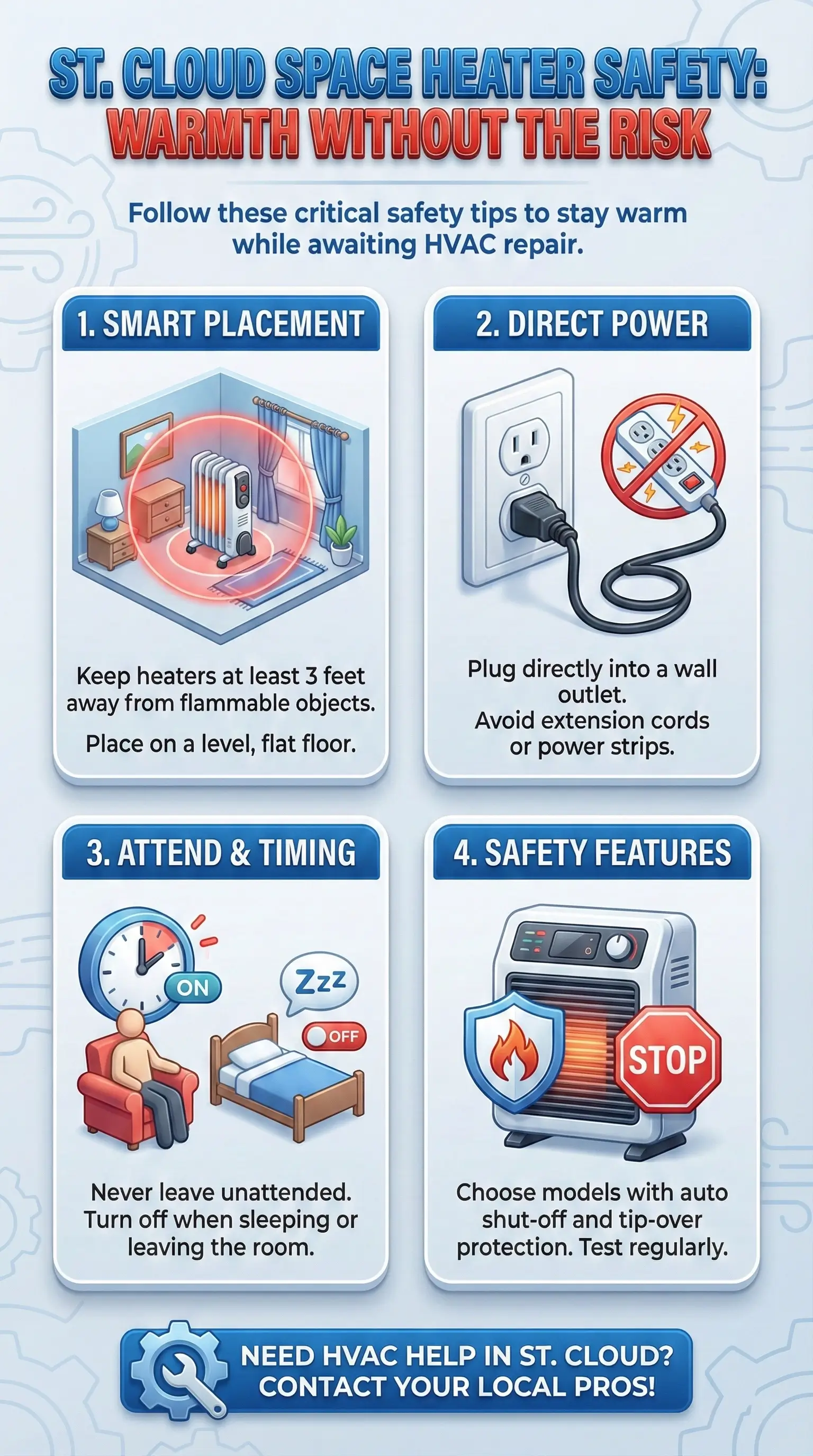
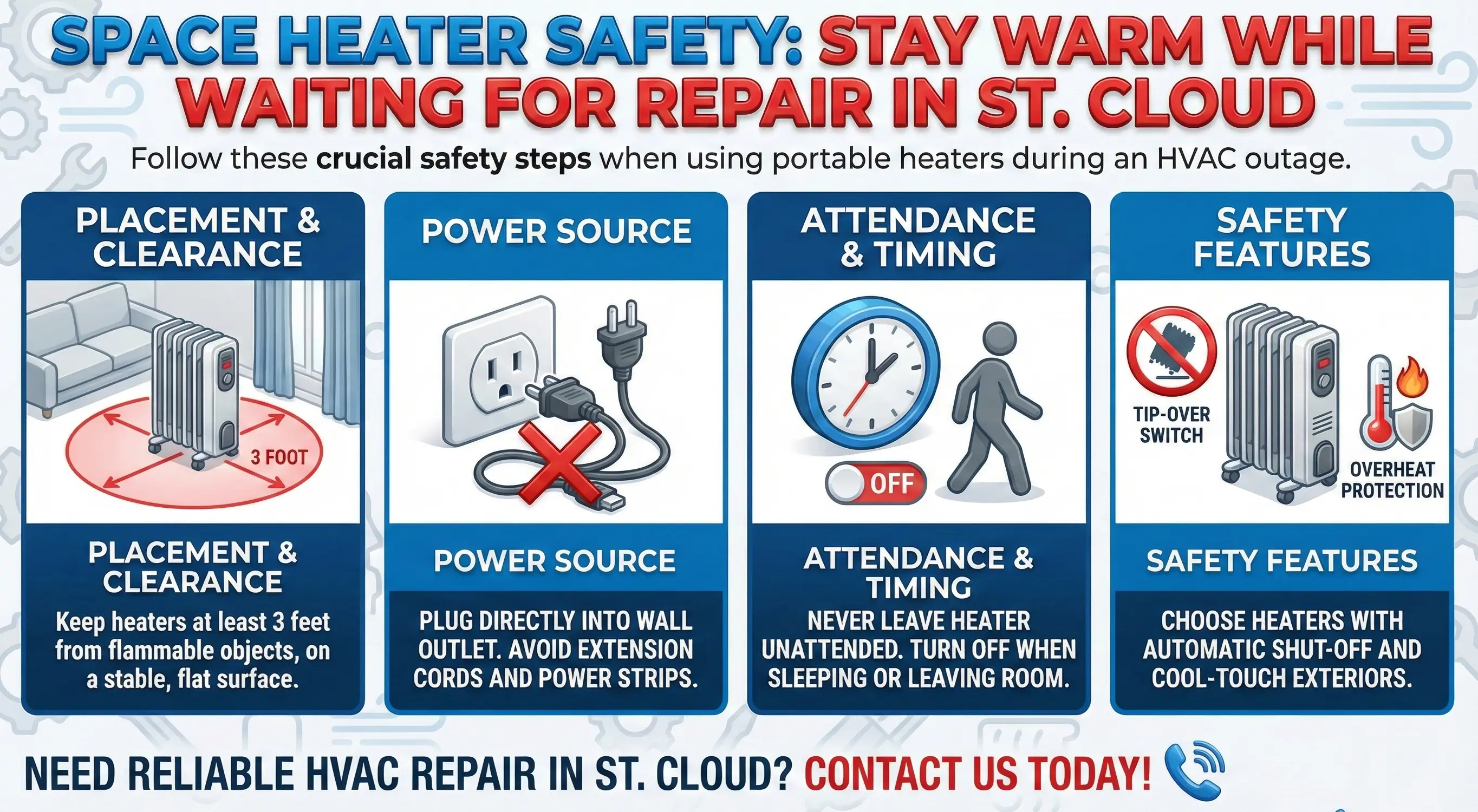
Emergency situations: Check thermostat batteries and circuit breakers before calling. Verify your air filter isn't completely clogged—this triggers safety shutdowns. If you need temporary heating while waiting for repair, use space heaters only with direct outlet connections (never extension cords) and maintain three-foot clearances around all heaters.
Local consideration: St. Cloud homes built before 1990 typically have 15-amp circuits that struggle with 1,500-watt space heater loads. Verify your electrical capacity before running multiple heaters during HVAC downtime.
Top Takeaways: Space Heater Safety During HVAC Repair
1. Check Your Electrical Circuits Before Plugging In Any Space Heater
The biggest danger isn't the heater—it's your home's electrical capacity.
St. Cloud homes built before 1990: Typically 15-amp circuits
A 1,500-watt space heater draws 12.5 amps alone
Most circuits already have other devices running
Action required: Identify which outlets share circuits and unplug non-essential devices first
2. Never Use Extension Cords With Space Heaters
This applies regardless of the cord's rating or gauge.
Extension cords create internal resistance
Resistance builds heat over hours of operation
We've traced multiple fires to cords that looked perfectly fine externally
If you can't reach an outlet directly, find a different heating solution
3. Demand Specific Repair Timelines—Not Vague Estimates
Push contractors for actual calendar dates, not "a couple days."
Realistic timelines:
Common parts: 1-3 days
Specialized components: 4-7 days
Heat exchangers or discontinued parts: 2-3 weeks
Knowing the real timeline day one helps you make informed decisions about temporary heating versus alternative shelter.
4. Consider Alternative Shelter After 48 Hours of Space Heater Use
Space heaters weren't designed for continuous multi-day operation as whole-home heating.
After two days of running multiple heaters, fire risk increases
Risk compounds through accumulated exposure time
Longer operation = more opportunity for electrical stress to cause problems
Staying with family or friends is safer than extended space heater reliance
5. Shut Down Immediately If You See These Warning Signs
Stop all space heater use and find alternative arrangements:
Repeated breaker trips (more than once per day)
Burning smells from outlets, cords, or heaters
Discolored or warm wall plates
Flickering lights when heater cycles on or off
These indicate electrical stress creating heat buildup inside your walls—exactly how electrical fires start in occupied homes.
Modern electric space heaters with tip-over protection and automatic shut-off features are your safest option during HVAC downtime. Skip any heater using combustion—propane, kerosene, or natural gas models create carbon monoxide risks that aren't worth taking in occupied spaces, even with ventilation.
We recommend ceramic or oil-filled radiant heaters for St. Cloud applications. Ceramic heaters heat rooms quickly, which matters when you're dealing with sudden cold snaps. Oil-filled radiant heaters work more slowly but maintain consistent temperatures without the fire risk of exposed heating elements. Both types handle Florida's humidity better than fan-forced models that can spread moisture throughout your home.
The wattage matters more than most homeowners realize. A 1,500-watt heater draws 12.5 amps on a standard 120-volt circuit. Most St. Cloud homes have 15-amp or 20-amp circuits, which sounds like plenty of headroom until you factor in everything else already running on that circuit.
Electrical Realities in St. Cloud Homes
Homes in established St. Cloud neighborhoods—particularly those built in the 1970s and 1980s around the Michigan Avenue and 10th Street corridors—typically have electrical panels sized for different usage patterns than today's demands. We've responded to multiple calls where homeowners tripped breakers repeatedly because they didn't realize their bedroom outlet shared a circuit with the garage refrigerator or the bathroom exhaust fan.
Before plugging in any space heater, check your electrical panel to see which outlets share circuits. If you don't have a circuit map, this is the time to create one. Plug a lamp into the outlet where you plan to run your space heater, then flip breakers one at a time until the lamp goes dark. Note everything else that stops working on that same breaker—those devices are sharing the circuit.
Run your space heater on a dedicated circuit whenever possible. If that's not an option, unplug non-essential items from the shared circuit before turning on the heater. The coffee maker, phone chargers, and TV can all wait. Your space heater needs the full circuit capacity.
Never use extension cords with space heaters. The resistance in extension cords creates heat, and that heat builds up over hours of operation. We've traced garage fires and wall outlet damage to extension cords that looked perfectly fine on the outside but had internal resistance problems. If you can't reach an outlet directly, you need a different heating solution for that space.
Placement Strategies That Prevent Fire Hazards
Space heaters need three feet of clearance in all directions. That includes furniture, curtains, bedding, clothing, and papers. This isn't a suggestion—it's based on actual ignition distances we've documented in fire investigations where space heaters were involved. Homeowners who frequently rely on space heaters may want to consider HVAC repair in St. Cloud to address underlying heating issues instead of depending on temporary solutions.
St. Cloud's older homes often have wood floors, and we've seen repeated issues with heat damage to flooring directly under space heaters. Place your heater on a hard, level, non-flammable surface. Ceramic tiles work well. Hardwood floors and vinyl plank can warp or discolor from sustained heat exposure.
Keep heaters away from high-traffic areas where someone could trip over them or knock them over. Position them where curious pets and small children can't reach them. The automatic tip-over switches work reliably on modern heaters, but they don't prevent the panic or potential injury from a hot heater falling over.
Bathrooms and kitchens are particularly dangerous locations for space heaters. The combination of water sources and electrical heating creates electrocution risks that multiply in Florida's humid climate. If your bathroom is uncomfortably cold, close the door after showering to trap residual heat rather than running a space heater.
Monitoring Temperature and Humidity During Space Heater Use
When you're heating individual rooms rather than your whole house, you create temperature differentials that drive moisture movement through your home. Warm, humid air naturally migrates toward colder surfaces, where it condenses. We've responded to multiple calls about "mysterious water damage" that turned out to be condensation problems from uneven heating during HVAC downtime.
Keep heated rooms within three degrees of unheated spaces. If you're running your bedroom at 72°F, try to keep the rest of your house at 69°F minimum. This prevents the moisture migration that causes condensation on windows, exterior walls, and in attic spaces.
Run a small fan to promote air circulation between heated and unheated areas. Leaving bedroom doors slightly open helps, as does running your ceiling fans on low speed in reverse mode (blowing air upward) to redistribute warm air that collects near the ceiling.
Monitor your indoor humidity levels. St. Cloud's outdoor humidity averages 75-85% during winter months. When you heat indoor air with space heaters, relative humidity drops, but absolute moisture content stays the same. If you notice condensation forming on windows or walls, you've created conditions where moisture problems can develop quickly.
Critical Warning Signs to Stop Space Heater Use Immediately
Some situations mean you need to shut down space heaters and find alternative arrangements regardless of outdoor temperatures. Repeated circuit breaker trips indicate electrical problems that won't improve with continued use. If you're resetting breakers more than once per day, your electrical system can't safely support your space heater usage.
Burning smells from outlets, cords, or the heater itself require immediate shutdown. Even if the smell dissipates, something caused it—either internal heater problems or external electrical issues. Don't restart the heater until you've identified and corrected the source.
Physical signs of electrical stress include discolored outlets, warm wall plates, or flickering lights when the heater cycles on. These indicate resistance problems in your wiring that create heat buildup inside your walls. This is exactly how electrical fires start in occupied homes.
If anyone in your household experiences headaches, dizziness, or nausea while space heaters are running, shut everything down and ventilate your home immediately. These are early carbon monoxide symptoms. While electric heaters don't produce carbon monoxide, these symptoms can also indicate inadequate ventilation or other air quality problems.
Realistic HVAC Repair Timelines in St. Cloud
Understanding how long you'll actually need space heaters helps you plan appropriately. Heating system repairs in St. Cloud typically take 1-3 days during our slower months (April through November). During peak season (December through March), expect 3-7 days from your initial call to completed repair.
Emergency service calls get faster response times—usually same-day or next-day appointments—but you'll pay premium rates. If your situation isn't truly dangerous, standard service appointments often make more financial sense even if they mean a few extra days with space heaters.
Parts availability significantly impacts repair timelines. Common components like igniters, flame sensors, and capacitors are typically in stock with local suppliers. Specialized parts for older systems or less common brands may require 2-5 business days for delivery. Heat exchangers, control boards, and compressors often mean week-long waits even during slower periods.
Complete system replacements take longer. If your HVAC contractor recommends replacement rather than repair, expect 5-10 days for equipment ordering, permitting, and installation. This timeline assumes normal conditions—complications with ductwork modifications, electrical upgrades, or permit delays can extend the process.
When to Seek Alternative Shelter
Sometimes space heaters aren't enough. If outdoor temperatures drop below 40°F for extended periods (rare in St. Cloud but possible during cold fronts), and your space heaters can't maintain indoor temperatures above 60°F, consider staying with family or friends until your HVAC system is operational.
Elderly household members, young children, and anyone with respiratory conditions are particularly vulnerable to sustained cold exposure. If you're constantly adding layers of clothing indoors and still feeling cold, your temporary heating solution isn't adequate for the conditions.
Extended HVAC downtime also strains space heater safety margins. Running multiple space heaters continuously for more than 48 hours increases fire risk simply through accumulated exposure time. The longer you operate temporary heating, the more opportunity exists for something to go wrong.
"I've been servicing HVAC systems in St. Cloud for over fifteen years, and I can tell you exactly when someone's been running space heaters unsafely—I see it the moment I open their electrical panel. The telltale signs are scorch marks around breaker connections and that distinct smell of overheated wire insulation. Just last January, I responded to a call on Indiana Avenue where a family had been running three space heaters for five days straight while waiting for their heat pump compressor to arrive. They were doing everything right with the heaters themselves—proper clearances, tip-over protection, the works—but they'd overloaded two circuits because they didn't realize their 1979 home wasn't wired for that kind of simultaneous load. We found temperatures above 140°F inside their wall cavities where the wiring ran. They were maybe 24 hours away from an electrical fire. The frustrating part is they thought they were being careful. That's why I always tell people: the heater safety features protect you from the heater, but nothing protects you from your home's electrical system except understanding its limits."
7 Resources We Share With Our St. Cloud Neighbors Before Every HVAC Repair Decision
Check Your Contractor's License—It Takes Two Minutes and Prevents Real Problems
After responding to service calls where unlicensed contractors left homeowners with dangerous installations, we always recommend checking MyFloridaLicense.com first. In my twenty years servicing St. Cloud, I've seen what happens when homeowners skip this step—incomplete repairs, voided warranties, and systems that fail inspection when you try to sell your home.
Understand if Repair Actually Makes Sense for Your System's Age
We use ENERGY STAR's resources at EnergyStar.gov when walking homeowners through repair-versus-replace decisions because it provides manufacturer-independent data. Living here in Central Florida myself, I know our climate puts different stress on systems than what national averages suggest—this tool accounts for our specific climate zone and helps you make decisions based on actual performance data rather than just repair quotes.
Don't Let Your Contractor Skip the Permit Process
The City of St. Cloud requires permits for major HVAC work, and you can verify requirements at StCloud.org. I've personally seen homeowners discover unpermitted work during home inspections, which delayed closings and cost thousands to rectify—your contractor should handle permitting as part of their service, and if they suggest skipping it, that's a serious red flag.
Claim the Rebates You've Already Paid For Through Your Electric Bill
Duke Energy Florida offers rebates at Duke-Energy.com that most St. Cloud homeowners don't realize they qualify for. We help our customers navigate these programs because I've seen families leave $500-$1,200 on the table simply because they didn't know these incentives existed—you're already funding these programs through your utility rates, so you might as well benefit from them.
Get the Real Facts on Indoor Air Quality Claims
When contractors start recommending expensive air quality upgrades, compare their claims against EPA's research at EPA.gov before committing. In my experience serving St. Cloud families, some air quality products deliver genuine health benefits while others are oversold—this resource helps you distinguish between solutions that matter and marketing hype.
Know What Weather's Coming Before Scheduling Non-Emergency Repairs
I check the National Weather Service forecast at Weather.gov/mlb before scheduling repairs because knowing when cold fronts arrive helps you avoid paying emergency rates for situations you could have planned around. Living here myself, I know St. Cloud's weather patterns well enough to tell you that most of our cold snaps are predictable 3-5 days out—this forecast office provides the detailed local data you need to make smart timing decisions.
Research Contractor Histories the Same Way We Vet Our Subcontractors
Before hiring any HVAC contractor in St. Cloud, check their BBB profile at BBB.org to see how they've handled customer complaints. When we need to refer work we can't handle ourselves, we use this same resource to vet contractors—complaint patterns tell you more about a company's values than their marketing materials ever will.
Supporting Statistics on Space Heater Safety and HVAC System Reliability
The numbers behind space heater incidents tell you what to expect. Seeing these statistics play out in real St. Cloud homes shows you what actually causes problems.
Space Heaters Cause 1,700 Home Fires Annually
The U.S. Consumer Product Safety Commission at CPSC.gov reports portable space heaters are involved in approximately 1,700 residential fires each year. This results in 80 deaths and 160 injuries nationally.
What this looked like during January 2024's cold snap in St. Cloud:
One scorched outlet on 13th Street from a heater running 36 hours straight
One tripped breaker that wouldn't reset on New York Avenue—circuit overload from heater plus refrigerator
One melted power cord on Michigan Avenue after 48 hours of continuous operation
None of these made it into fire statistics because we caught them early. All three were days away from becoming structure fires if the homeowners had continued their current practices.
Heating Equipment Fires Peak During Cold Weather
The National Fire Protection Association reports at NFPA.org that 44% of home heating equipment fires occur in December, January, and February. Peak incident rates correspond to the coldest days in each region.
Our emergency call pattern in St. Cloud:
January 17, 2024: Temperatures hit 32°F overnight
We received 14 emergency heating calls before noon
Normal winter week average: 2-3 emergency calls total
Fire risk peaks because heaters are operated by people who use them once or twice yearly
The pattern repeats every year. Cold fronts arrive, dormant heating systems fail to start, and families reach for space heaters without considering electrical capacity.
HVAC Accounts for 50% of Your Electric Bill
The U.S. Department of Energy confirms at Energy.gov that heating and cooling combined account for about repa.
Real example from Ohio Avenue, February 2024:
Heat pump failed during week-long cold spell
Customer ran four space heaters for six days waiting for compressor replacement
Normal February bill: $180
That month's bill: $387
Four 1,500-watt heaters collectively drew 6,000 watts continuously
Result: Equivalent of running a second HVAC system with zero efficiency features
The homeowner said they would have paid for emergency weekend service if they'd known space heaters would add $200 to their repair costs.
Electrical Failures Cause 33,000 Home Fires Yearly
The U.S. Fire Administration at USFA.fema.gov shows electrical distribution and lighting equipment causes approximately 33,000 residential fires annually. Extension cords and plug connections are common failure points.
Why St. Cloud's home age matters:
Most homes I service: Built 1975-1990 around Michigan Avenue and 10th Street
Wiring age: 35-50 years old
Common issues: Aluminum wiring or early copper with brittle insulation
Connection points develop resistance over decades
Breakers wear out from thermal cycling
Real situation from Massachusetts Avenue, last winter:
I opened a junction box to diagnose repeated breaker trips with a space heater. The wire nuts inside were discolored brown from heat stress. The wire insulation crumbled when I touched it. That's a fire waiting to happen—the space heater just exposed an electrical system that was already failing.
Final Thoughts on Space Heater Safety During HVAC Downtime
Space heaters work as temporary heating solutions if you respect their limitations and understand your home's electrical capacity. The key word is temporary—these devices were designed for occasional use, not as multi-day heating system replacements.
The Real Risk Nobody Talks About
After two decades servicing HVAC systems throughout St. Cloud, I've learned the biggest danger isn't the space heater itself. Modern heaters have excellent safety features. The real risk is the gap between what homeowners think they know about their electrical systems and what's actually happening inside their walls.
Most St. Cloud homeowners don't know:
Which outlets share circuits
How old their wiring actually is
What load capacity their system can handle
Where junction boxes and connection points are located
When your heat pump fails at midnight and it's 38°F outside, you're making electrical decisions based on assumptions rather than facts.
The Industry's Timeline Problem
The HVAC industry has done a poor job educating homeowners about realistic repair timelines. We're good at quoting prices. We're terrible at managing expectations on wait times.
Parts availability controls everything:
Flame sensor for common Carrier furnace: In my truck right now
Control board for 12-year-old Goodman heat pump: 4-7 day wait if not in local stock
Heat exchanger for discontinued Trane model: 2-3 weeks best case scenario
When I tell a family their repair will take five days, I'm asking them to operate electrical equipment they don't fully understand for longer than those devices were designed to run continuously. That's where risk compounds.
What I Tell My Own Family
If your heating system fails and the repair timeline exceeds 48 hours, seriously consider staying with family or friends. I know that's disruptive and inconvenient. But I've responded to too many emergency calls that started with "we've been running space heaters for almost a week."
For situations where you have no alternative:
Treat space heaters like candles—never leave them unattended
Never run them while sleeping
Check on them hourly when operating
This is excessive by manufacturer standards but realistic based on what I've seen go wrong
Temperature Discomfort vs. Actual Danger
Nobody talks about this distinction. If your indoor temperature is 58-62°F, that's uncomfortable but not dangerous for most healthy adults.
You can survive comfortably by:
Adding layers and using blankets
Sleeping in the warmest room of your house
Heating one or two rooms instead of the entire home
Focusing on preventing pipe freezes rather than achieving 72°F everywhere
Why Safety Advice Fails in Real Situations
Most safety guides assume you have perfect information about your electrical system and unlimited attention span for monitoring devices. Real life doesn't work that way.
You're tired, cold, worried about repair costs, and you just want your house to feel normal again. That's when mistakes happen—not because you're careless, but because you're human operating outside your expertise for longer than anyone should have to.
What Our Industry Needs to Change
If I could fix one thing about how we handle HVAC failures:
Stock more common parts locally
Maintain better supplier relationships for genuine emergency priority
Be honest about repair timelines from the initial phone call
Help customers make informed decisions about temporary heating vs. alternative shelter
My Advice as Both Technician and St. Cloud Homeowner
Living here myself, I've been the homeowner making these decisions, not just the technician explaining them.
Here's what I'd tell my own sister:
Get a realistic timeline from your contractor immediately—not "a couple days" but actual calendar dates
Verify your space heater electrical situation before running multiple units
Don't hesitate to make alternative shelter arrangements if repairs extend beyond 2-3 days
Your safety matters more than the inconvenience of staying somewhere else temporarily
When you know day one that a repair will take a week, you can make better decisions than when you're told "we'll have you fixed up soon" and find yourself on day six still waiting for parts.
FAQ on HVAC Repair in St. Cloud
Q: How long does HVAC repair typically take in St. Cloud?
A: Timeline depends on season and parts availability.
Slower months (April-November):
Most repairs: 1-3 days from call to completion
Common parts in stock locally
Peak season (December-March):
Standard appointments: 3-7 days
Every contractor in Central Florida is slammed
Suppliers often backordered across three states
What controls your actual timeline:
Capacitors and igniters: In my truck right now
Control boards for 8+ year old systems: 4-7 business days to order
Heat exchangers and discontinued parts: 2-3 weeks (usually recommend replacement instead)
Emergency calls: Same-day response but cost $150-$200 extra
Q: Do I need a permit for HVAC repair work in St. Cloud?
A: Depends on the type of work.
Requires permits:
System replacements
Ductwork modifications
Electrical upgrades
No permit needed:
Capacitor replacement
Coil cleaning
Thermostat replacement
Important facts:
Your contractor should handle permitting
Permit costs included in legitimate quotes
I pull permits for every job requiring them
Real consequence I've seen:
Massachusetts Avenue home sale nearly fell through in 2023
Inspection revealed unpermitted 2019 system replacement
Seller paid for retroactive permitting, re-inspection, and price concessions
If contractor suggests skipping permits, you're talking to someone who'll leave you with liability
Q: How much should I expect to pay for HVAC repair in St. Cloud?
A: Costs vary by repair complexity.
Diagnostic and minor repairs:
Diagnostic fee: $95 (service call and evaluation)
Capacitors or thermostat issues: $200-$350 total
Mid-range repairs:
Control boards: $500-$1,000
Blower motors: $500-$1,000
Gas valves: $500-$1,000
Major component replacement:
Compressors: $2,000-$3,500
Heat exchangers: $2,000-$3,500
At these prices, usually recommend replacement instead
Complete system replacement:
Basic efficiency: Starting around $5,000
High-efficiency systems: $10,000+
Real example from Ohio Avenue last month:
Quotes for identical equipment ranged from $4,200 to $8,500
Difference: Warranty coverage and ductwork modifications
Always get written quotes and verify warranty details
Q: Should I repair or replace my HVAC system?
A: Age and repair cost determine the best decision.
Clear recommendations:
Under 8 years old with minor failure: Repair it
Over 12 years old with major failure: Replace it
8-12 years old: Requires case-by-case evaluation
Three factors I consider:
1. Repair cost vs. replacement cost
If repair exceeds 50% of new system cost, replace instead
2. Your repair history
Spent $1,000+ on repairs in past two years? You're putting money into a failing system
3. Efficiency gains
Real example from 13th Street, February 2024:
Customer's 15-year-old system cost $65/month more in electricity than new high-efficiency unit
Over new system's lifespan: $11,000 in energy savings
Savings more than covered replacement price
Q: What should I do immediately after my HVAC system fails?
A: Check three things before calling a contractor.
Step 1: Check thermostat batteries
Replace batteries first
I've driven to "emergency" calls where $4 batteries solved the problem
Step 2: Check circuit breaker panel
Look for tripped breakers
Reset if necessary
Step 3: Inspect air filter
Recent New York Avenue call: Filter so clogged it was bowed outward
Triggered system's safety shutdown
Simple filter change fixed the issue
If basics don't solve it:
Call licensed contractor immediately
Stop trying to restart the system
Repeated restart attempts damage components that would otherwise be salvageable
While waiting for repair:
Close off unused rooms
Concentrate heating/cooling in essential spaces
Use proper space heater safety if needed for temporary heating
Never use extension cords with space heaters
Maintain three-foot clearances around all heaters
Get Your St. Cloud Heating System Fixed Right—Before Space Heaters Become a Bigger Risk
Space heaters work temporarily, but your family deserves the safety and comfort of a properly functioning heating system. Call Filterbuy HVAC Solutions today for honest repair timelines, upfront pricing, and the kind of service we'd provide for our own St. Cloud neighbors—because we live here too and understand exactly what you're dealing with.
Learn more about HVAC Care from one of our HVAC solutions branches…
Filterbuy HVAC Solutions - West Palm Beach FL
1655 Palm Beach Lakes Blvd., Ste 1005 West Palm Beach, FL 33401
(561) 448-3760
https://maps.app.goo.gl/VarpgNZnxuPQuW8A7